%20(200%20x%2050%20mm)%20(100%20x%2020%20mm).png)
%20(200%20x%2050%20mm)%20(100%20x%2020%20mm)%20(20%20x%20100%20mm).png)
%20(4).png)
The Invisible Cost of Misalignment: Why Internal Friction Is Your Competitor's Greatest Advantage
The short answer: When B2B deals stall, the root cause is almost never the market. It's internal incentive misalignment—a structural conflict between Sales, Finance, and Product that leaks directly into the buyer's decision process. This article explains why it happens and what to do about it.
Why Do High-Value B2B Deals Really Stall?
When a complex technology company sees ARR flatten, the first instinct is always the same.
Blame sales execution. Blame the product gap. Blame the messaging.
Understandable. Also wrong.
When high-value B2B deals stall or margins erode, the problem is almost never outside the building. It's inside - buried in theformal rules that govern how departments are measured, rewarded, and forced to compete with each other.
That's not a motivation problem. That's a structural governance failure.
And it has a name: internal incentive misalignment.
Why Do Departmental Silos Form in the First Place?
We love the word "silos." It sounds like a culture problem. A communication problem. A "we just need better teamwork" problem.
It isn't.
Departments don't isolate themselves because their people are difficult. They isolate themselves because the rules someone wrote -usually years ago, usually with good intentions - make cooperation structurally irrational.
Look at what each department is actually incentivized to do:
- Sales - Close volume. Hit ARR targets. Every friction point is the enemy. A discount? A promise about an unreleased feature? Whatever removes the barrier.
- Finance & Pricing - Protect margin. Treat every deal as a risk until proven otherwise. Long approval cycles aren't a failure. They're the mechanism.
- Product & Engineering - Protect capacity and stability. Customization requests aren't opportunities. They're threats.
When these metrics collide, the war moves inward.
Not against the competitor. Against each other.
Because the bonus structure makes it zero-sum: what'sgood for Sales is a direct threat to Finance. What Finance protects, Productresents.
How Does Internal Misalignment Affect Your Sales Pipeline?
This is the part most leadership teams miss entirely.
A B2B buyer evaluating a complex technology solution isn't just buying software. They're buying an institutional relationship. They're trying to answer one quiet question: does this organization actually function?
When your internal machinery is unsynchronized, they sense it. Not in a meeting agenda. Not in a slide deck. They feel it in the seams:
- A price that shifts between conversations.
- Technical promises that quietly dissolve by the time the contract arrives.
- "We'll check and get back to you" - on repeat.
Their brain registers this as systemic risk. And then they freeze. They escalate to a committee. They demand a discount to compensate for the uncertainty they can't name but definitely feel.
The buyer didn't stall because your solution is weak.
They stalled because they felt your internal chaos through the meeting.
That's what B2B decision friction looks like from the outside. It starts on the inside.
What's the Actual Fix for Sales Cycle Friction?
The fix doesn't live at the level where the symptom appears.
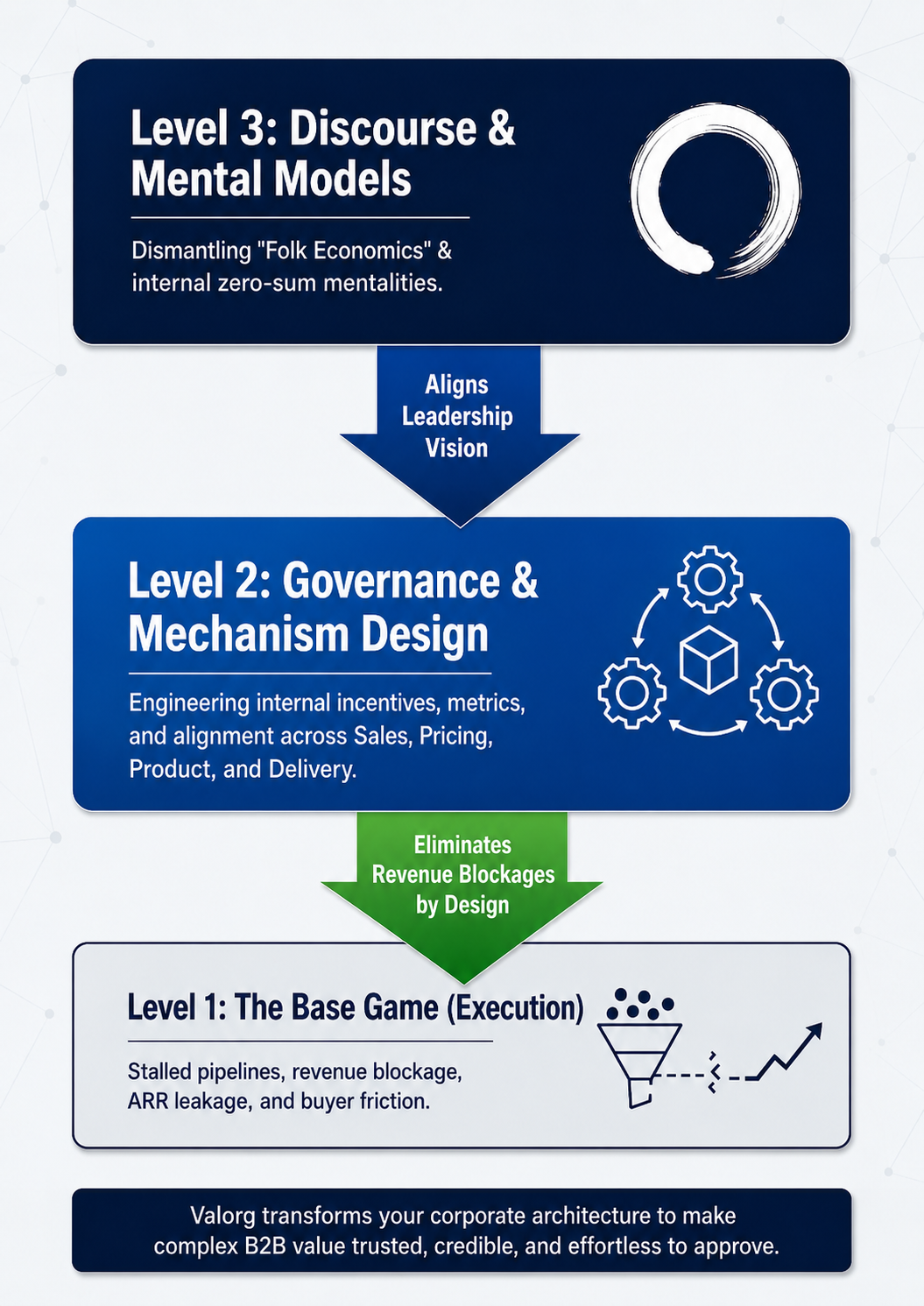
There are three layers to every organization:
Layer 3: Discourse - Mental models and shared language
Layer 2: Governance - The rules of the game ← Fix it here
Layer 1: Base Game - Daily actions and results ← See it here
Most companies try to solve a Layer 1 problem with Layer1 tools.
New sales scripts. Another training program. A better CRM.
That's giving a patient painkillers instead of diagnosingthe cause. The pain moves. The problem doesn't.
Layer 2 is where you fix the game. Re-engineer the metrics, the internal agreements, and the incentive structure - so that nodepartment can claim a win unless the deal simultaneously protects margins and removes friction for the buyer.
Layer 3 is the language. Leaders need to dismantle what Icall Folk Economics inside the firm - the old belief that a win for the customer means a loss for the company. That a win for Sales is a loss for Product.
It isn't true. It just feels true because the old rules make it that way.
How to Run an Internal Incentive Audit
If you want to unlock your pipeline and protect yourmargins - without dropping your price - stop looking for the problem outside.
Do this this week:
- Put your heads of Sales, Pricing, and Product in one room.
- Write their quarterly bonus metrics side-by-side on a single board.
- Find the exact points where one department's target structurally punishes another department's objective.
When you align the internal rules, you can do something most companies can't: make a credible commitment to the market.
When your organization reaches what I call organizationalsynchronization - aligned around one clear, uncompromised business case -the buyer doesn't need to freeze.
They can approve.
FAQ
Q: Does incentive misalignment only affect large enterprises? No. The conflict appears earlier than most founders expect—often moment a dedicated Sales function separates from product. The scale is smaller. The damage is proportionally the same.
Q: Is this the same problem as "sales and marketing alignment"? No. Sales-marketing alignment is about messaging consistency. This is about the formal rules that determine how departments are rewarded—a structural problem that sits one level deeper.
Q: Can this be fixed without a full organizational restructure? Yes. The starting point is always an internal incentive audit mapping where one department's metric structurally punishes another's. That single exercise surfaces the conflict. What you do with it is a separate conversation.
Dr. Amir Kahani | Valorg - B2B Strategic Advisory Helping complex technology companies eliminate decision friction from high-stakes deals.